
Koopman Theory for Robot Learning and Control
We develop Koopman-based methods that turn nonlinear robot dynamics into useful linear representations for scalable learning, prediction, control, and safety.
Overview
Robots are governed by nonlinear dynamics, especially when they walk, make contact, manipulate objects, or operate near obstacles. These dynamics are difficult to model accurately and can make real-time optimization expensive. Koopman operator theory offers a different perspective: instead of directly linearizing a nonlinear system around one operating point, it lifts the system into a richer space of observable features, where its evolution can be approximated by linear dynamics.
Our research asks how this idea can become a practical foundation for robot learning and control. We develop data-driven Koopman representations that can be learned from vision and robot trajectories, refined continually as new data arrive, scaled to high-dimensional systems, and combined with safety constraints. This creates a bridge between expressive learned models and efficient, well-understood linear control tools such as model predictive control and quadratic programming.

Research Directions
Learning Koopman Representations from Vision
Dexterous manipulation involves complex interactions between a robot hand and the objects in a scene. Classical Koopman methods often assume access to ground-truth object states, but those states may be unavailable outside carefully instrumented environments. KOROL learns visually interpretable, task-relevant object features directly from images and uses a Koopman operator to roll those features and robot states forward in time. The learned representation supports trajectory propagation without requiring ground-truth object states at runtime, extending Koopman-based manipulation from simulation to real-world visual observations.
Publications:
-
[C84] KOROL: Learning Visualizable Object Feature with Koopman Operator Rollout for Manipulation
Hongyi Chen, Abulikemu Abuduweili, Aviral Agrawal, Yunhai Han, Harish Ravichandar, Changliu Liu and Jeffrey Ichnowski
Conference on Robot Learning, 2024
Continual Koopman Learning for Legged Robots
Koopman Learning and Control for High-Dimensional Robots
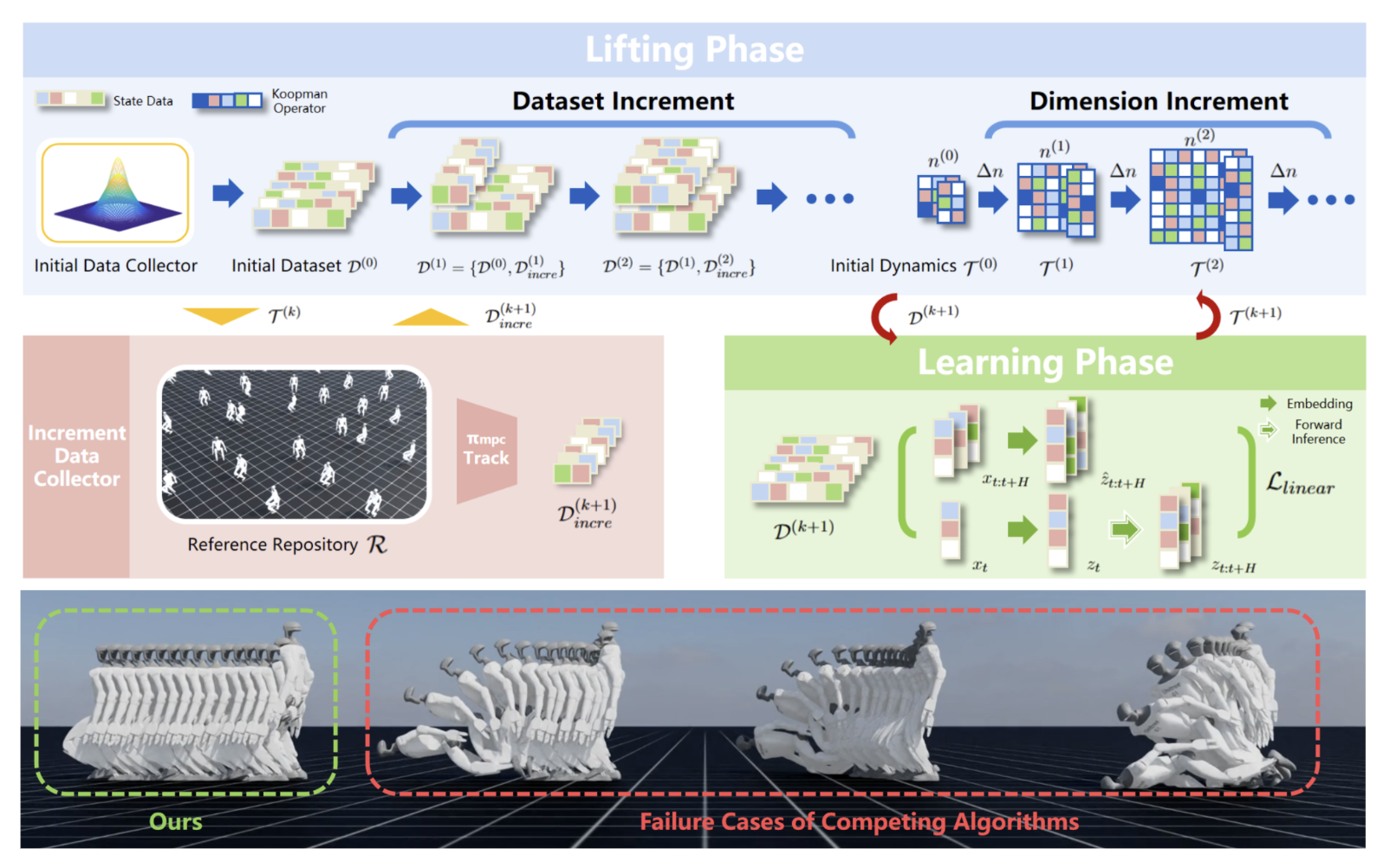
Humanoids and quadrupeds have high-dimensional nonlinear dynamics that change across robots, motions, and terrains. A fixed lifted model may therefore be too limited or become inaccurate under a domain shift. Our continual learning approach progressively expands both the training dataset and the latent representation, refining the Koopman dynamics as new experience becomes available. The method provides monotonic convergence of the linear approximation error and enables simple linear model predictive controllers to control Unitree G1, H1, A1, and Go2 robots as well as ANYmal D across diverse terrains.
Publications:
-
[C95] Continual Learning and Lifting of Koopman Dynamics for Linear Control of Legged Robots
Feihan Li, Abulikemu Abuduweili, Yifan Sun, Rui Chen, Weiye Zhao and Changliu Liu
Learning for Dynamics and Control Conference, 2025
Safe Whole-Body Control
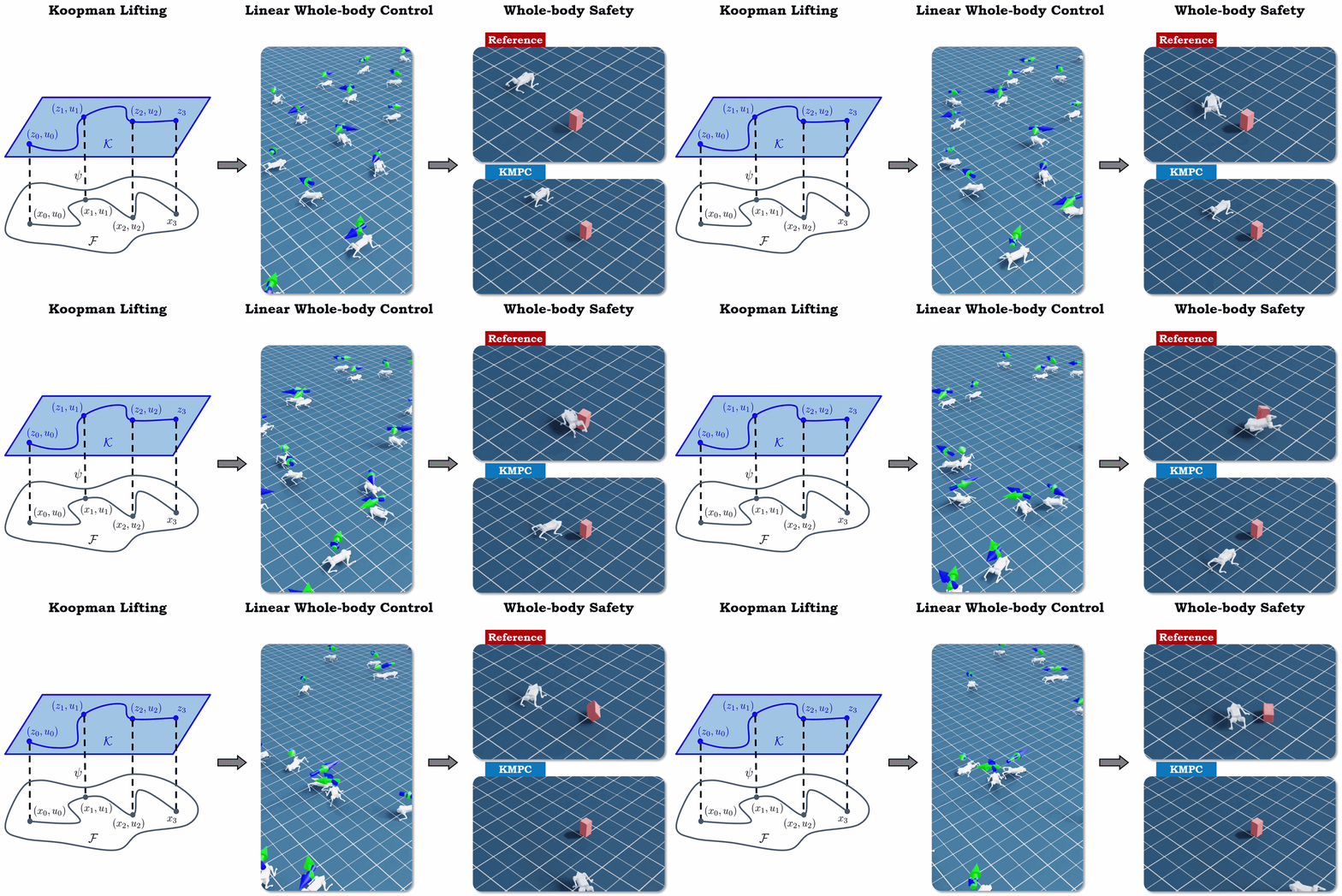
 Learning a useful dynamics model is only part of the control problem: a robot must also track its task while respecting safety constraints in real time. We present
 KMPC, which integrates the learned Koopman neural dynamics with the Safe Set Algorithm so that tracking and safety are handled together in a single quadratic program. The lifted linear representation keeps the online optimization efficient, while the unified formulation avoids adding a separate safety filter after the task controller. Experiments on a Kinova Gen3 manipulator and a Unitree Go2 quadruped demonstrate accurate tracking and obstacle avoidance for strongly nonlinear systems.
Application to Robotic Arms
Application to Legged Robots
The lifted linear structure also makes hardware deployment inexpensive. Rather than retraining the neural embedding, we collect a small amount of hardware data and fine-tune only the Koopman matrices A and B, since the dominant simulation-to-hardware mismatch, arising from actuation differences and unmodeled dynamics, is largely captured by the linear dynamics in the lifted space. This keeps the learned latent coordinates intact while substantially reducing prediction error on the real robot. The same unified safe controller therefore transfers directly to the actual robot without retraining the embedding.
Sim-to-Real Transfer
Publications:
-
[C109] Whole-Body Safe Control of Robotic Systems with Koopman Neural Dynamics
Sebin Jung, Abulikemu Abuduweili, Jiaxing Li and Changliu Liu
IEEE International Conference on Robotics and Automation, 2026
Scaling Laws for Neural Koopman Operators
Data-driven Koopman models depend on two coupled resources: the amount of training data and the dimension of the lifted space. We study how these quantities should scale together by decomposing approximation error into sampling error and projection error. The resulting theory connects dataset size and latent dimension to model accuracy and downstream control quality. We also introduce covariance and inverse-control regularizers that stabilize learned features and align the representation with physical actuation. Experiments across six robotic environments turn these results into practical guidance for allocating data and model capacity.
Publications:
-
[U] Scaling Law of Neural Koopman Operators
Abulikemu Abuduweili, Yuyang Pang, Feihan Li and Changliu Liu
arXiv:2602.19943, 2026
Unifying Goal
Together, these projects develop a Koopman pipeline that spans perception, continual model learning, control, and safety. The long-term goal is to give robots models that retain the computational advantages of linear systems while remaining expressive and adaptable enough for nonlinear, high-dimensional, real-world operation.
Research portfolio
2023–Now
Prompt-to-Product: Unleashing Creativity with AI and Robots
CMU Manufacturing Futures Institute
2023–Now
Humanoid Robots: Safety and Dexterity
2023–Now
Neural-Symbolic Robotics: Learning and Reconfiguring Task Structure
2022–Now
Toward Lifelong Safety of Autonomous Systems in UIE
National Science Foundation
2025–2026
PerSEVE (Perception by Segmentation, Extensible Visual Ecosystem)
Advanced Robotics for Manufacturing Institute
2024–2026
Koopman Theory for Robot Learning and Control
Current project
2023–2025
State-wise Safe and Robust Reinforcement Learning for Continuous Control
2021–2025
Real-Time Systems for Human-Robot Interaction and Industrial Metaverse
Siemens
2023–2024
Enhancing and Verifying the Robustness of Learning-based Systems
The Boeing Company
2019–2024
Automatic Onsite Grinding of Large Complex Surfaces
Advanced Robotics for Manufacturing Institute
2022–2023
Proactive Safe Human-Robot Interaction
CMU Manufacturing Futures Institute
2020–2022
Safe Uncaged Industrial Robots
Ford Motor Company
2020–2021
Hierarchical Motion Planning for Efficient and Provably Safe HRI
Amazon Research Award
2019–2021
6DoF Robot Assembly Station of Consumer Electronic Production
Efort
2019
Adaptable Behavior Prediction for Autonomous Driving
Holomatic
2012–2018
Past Projects