
Neural-Symbolic Robotics: Learning and Reconfiguring Task Structure
Connecting human intent, symbolic task structure, and learned visuomotor control.
Neural-Symbolic Robotics
Robots must turn human intent into reliable behavior in a physical world. This requires more than language understanding or end-to-end policy learning alone: robots need task structures that express what should happen, learned controllers that determine how to act, and mechanisms to adapt both at deployment time.
Our work develops a neural-symbolic stack for this problem. We represent long-horizon tasks through hierarchical temporal logic and task trees; use those structures to plan, allocate, and execute work across robots; learn symbolic automata directly from visuomotor trajectories; and reconfigure learned task structure at inference time to steer behavior toward new, physically feasible preferences.
Research Themes
1. Specify complex tasks through hierarchy
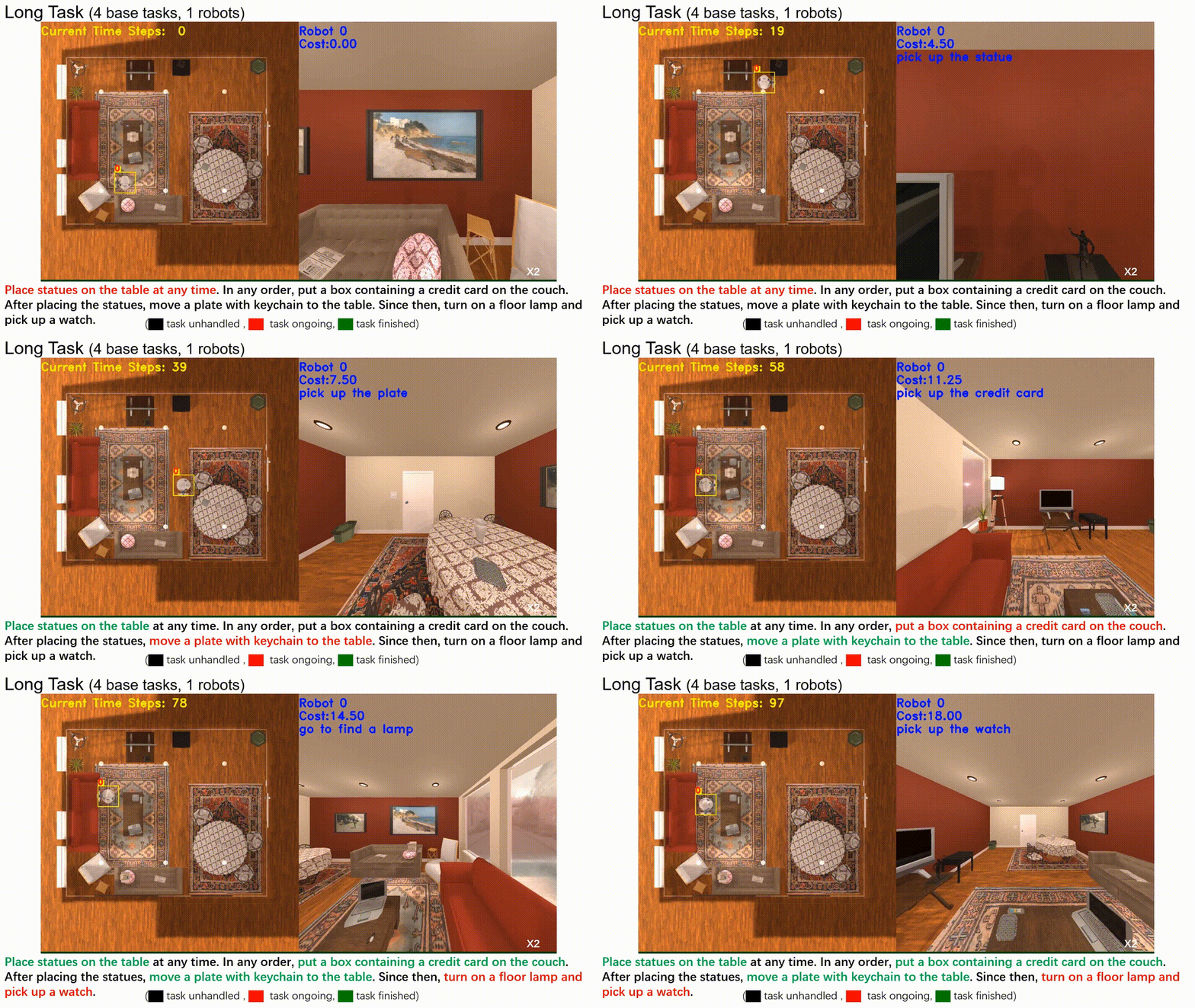
Flat temporal-logic formulas become lengthy, difficult to interpret, and expensive to solve as tasks grow. We introduced hierarchical temporal logic specifications with explicit syntax and semantics for composing task objectives across levels of abstraction. This representation is more expressive than flat specifications, easier for people to understand in user studies, and supports scalable decision making for multi-robot systems.
We developed complementary planning methods that integrate task allocation with planning: search over loosely coupled specification subspaces, decomposition into atomic subtasks and task networks, and hierarchical task-and-motion planning that connects symbolic objectives to feasible robot motion.

Publications
-
[J33] Simultaneous Task Allocation and Planning for Multi-Robots under Hierarchical Temporal Logic Specifications
Xusheng Luo and Changliu Liu
IEEE Transaction on Robotics, 2025
-
[J25] Decomposition-based Hierarchical Task Allocation and Planning for Multi-Robots under Hierarchical Temporal Logic Specifications
Xusheng Luo, Shaojun Xu, Ruixuan Liu and Changliu Liu
IEEE Robotics and Automation Letters, 2024
-
[C99] Hierarchical Temporal Logic Task and Motion Planning for Multi-Robot Systems
Zhongqi Wei, Xusheng Luo and Changliu Liu
Robotics: Science and Systems, 2025
2. Translate human instructions into executable structure
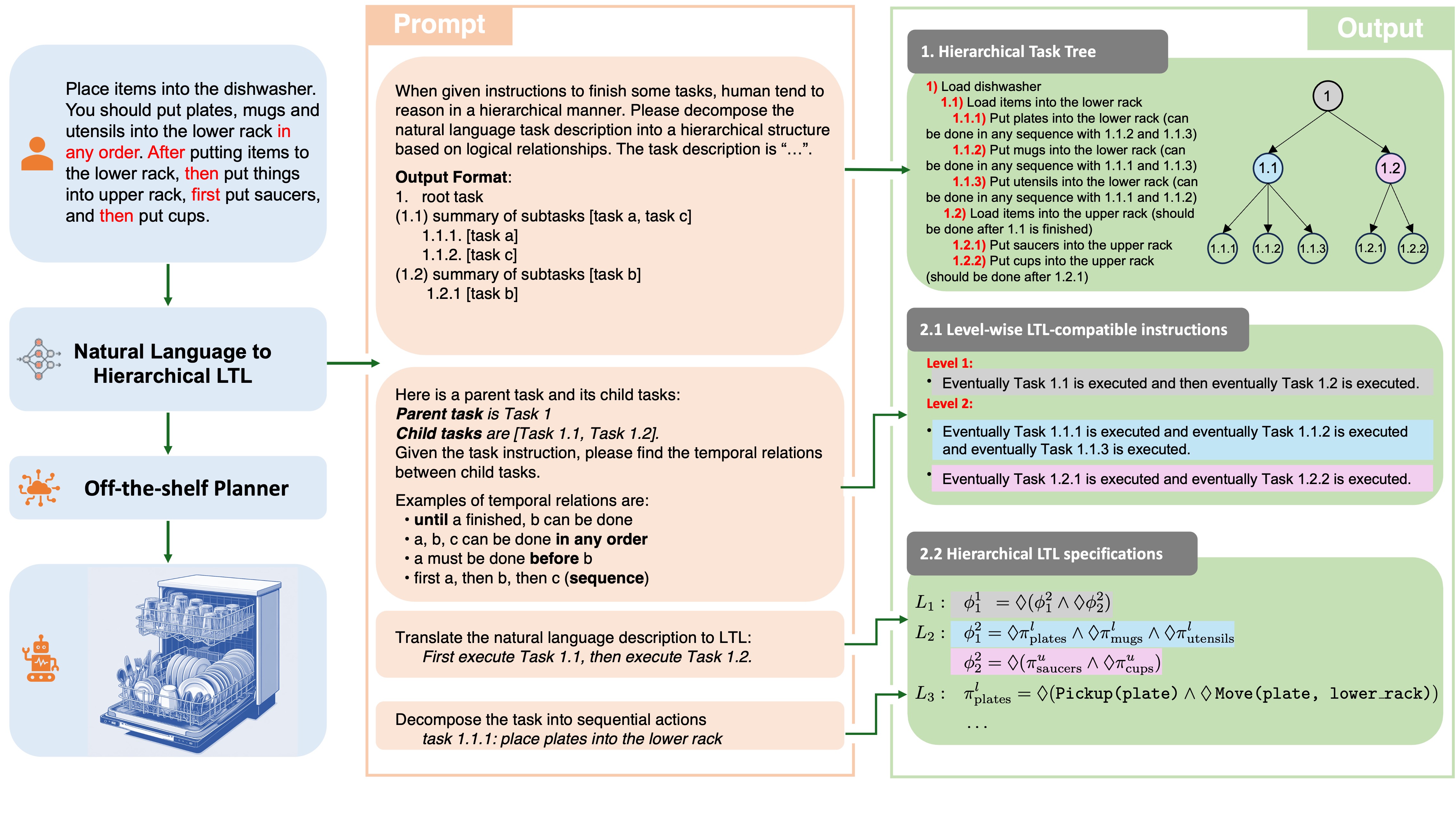
Natural-language instructions often leave temporal order, logical alternatives, and multi-robot responsibilities implicit. We bridge this gap by translating instructions into hierarchical task structures and then into hierarchical Linear Temporal Logic (LTL). The hierarchy retains intent while exposing ordered robot actions that standard planners can execute.
NL2HLTL2Plan uses language models in two stages: it first constructs a hierarchical task tree, then converts subtasks into LTL formulas that form an executable hierarchy. The resulting specifications support more complex instructions while improving task-allocation and planning success and cost. Earlier work established the foundation for obtaining hierarchy directly from human instructions with LLMs.
Publications
-
[J35] NL2HLTL2Plan: Scaling Up Natural Language Understanding for Multi-Robots Through Hierarchical Temporal Logic Task Specifications
Shaojun Xu, Xusheng Luo, Yutong Huang, Letian Leng, Ruixuan Liu and Changliu Liu
IEEE Robotics and Automation Letters, 2025
-
[W] Obtaining hierarchy from human instructions: an llms-based approach
Xusheng Luo, Shaojun Xu and Changliu Liu
CoRL 2023 Workshop on Learning Effective Abstractions for Planning (LEAP), 2023
3. Learn symbolic structure from visuomotor experience
Hand-designed symbols can limit robot learning. We instead learn an emergent neural automaton policy from visuomotor trajectories. The model discovers a high-level state-machine skeleton that captures task progress, together with a continuous residual controller that realizes each stage in the physical world. This makes latent task structure explicit without requiring manually predefined symbolic states.

Publication
-
[C112] Emergent Neural Automaton Policies: Learning Symbolic Structure from Visuomotor Trajectories
Yiyuan Pan, Xusheng Luo, Hanjiang Hu, Peiqi Yu and Changliu Liu
Robotics: Science and Systems, 2026
4. Reconfigure task structure to steer learned behavior
Learned policies should follow new user preferences at test time without costly retraining. ReStruct steers a frozen neural automaton policy by modifying its symbolic task skeleton and updating its action priors, while preserving the learned low-level controller. This allows robots to satisfy object-centric preferences and temporal-logic constraints through physically aware task-structure reconfiguration.

Publication
-
[C119] Inference-Time Robot Behavior Steering through Physically-Aware Reconfiguration of Task-Structure
Yiyuan Pan, Hanjiang Hu, Shangtao Li, Xusheng Luo and Changliu Liu
Conference on Robot Learning, 2026
From Language to Physical Behavior
- Human instruction
- Describe desired outcome, alternatives, order, and collaboration.
- Hierarchical task structure
- Infer temporal and logical relations; compile intent into executable specifications.
- Planning and control
- Allocate subtasks, synthesize task-and-motion plans, and execute with robot controllers.
- Learned automata and steering
- Discover structure from trajectories, then reconfigure it at inference time to meet new preferences while respecting physical feasibility.
Together, these directions make symbolic structure a living interface between people, planners, and learned robot policies—not a fixed description written once before deployment.
Research portfolio