
Humanoid Robots: Safety and Dexterity
Safe, capable, and human-centered whole-body intelligence for humanoid robots.

WHY HUMANOIDS?
Human-shaped robots need whole-system intelligence
Humanoid robots can navigate human spaces, use human tools, and learn from human motion—but their high-dimensional dynamics and rapidly changing contacts make every useful behavior a control and safety challenge.
Our research treats safety, control, learning, and manipulation as connected parts of one system. We study how a robot can model its dynamics, coordinate its body, recognize when recovery remains possible, transfer behaviors to hardware, and combine reusable skills into useful work.
Safety is both a controller and a prediction problem. SPARK and p-SSA enforce geometric constraints, while PRISM and λ-Reachability characterize states from which safe behavior remains possible.
Explore safety researchControl must remain fast as complexity grows. Koopman methods lift nonlinear robot dynamics into representations that support efficient linear control, while HOVER and ASAP address multi-mode behavior and sim-to-real mismatch.
Explore control researchAutonomy connects motion with task-level reasoning. Human-to-humanoid systems capture whole-body skills; VIRAL and NeSyPack study visual loco-manipulation and structured logistics packing.
Explore manipulation researchHUMANOID SAFETY
Protect the robot before failure becomes unavoidable
Safety spans fast control corrections, state-level monitors, and reusable infrastructure that carries safety methods from simulation to hardware.
OPEN SAFETY INFRASTRUCTURE
SPARK
Safe Protective and Assistive Robot Kit
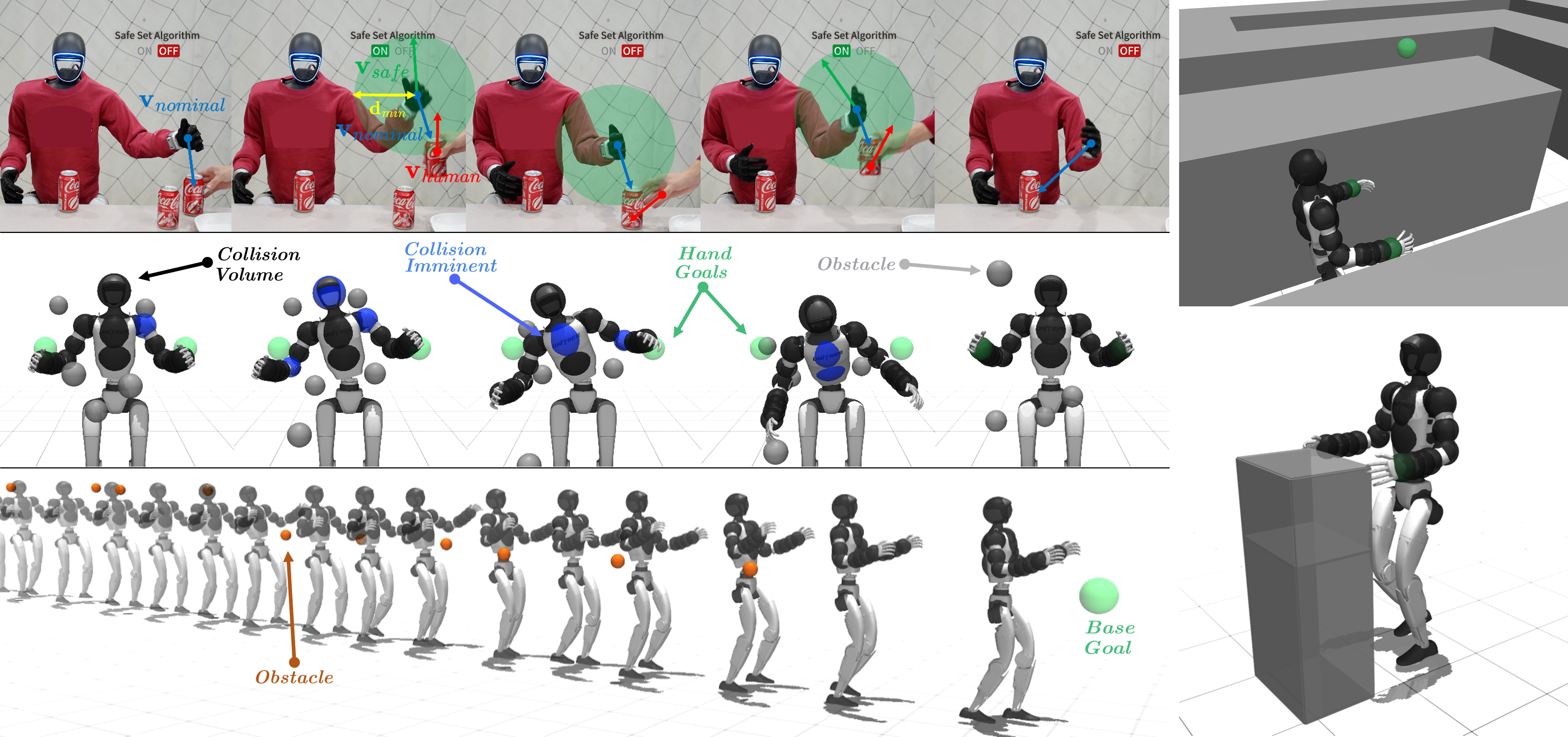
SPARK is an open-source benchmark and toolbox for configuring safety criteria, comparing safe-control approaches in simulation, and deploying synthesized controllers on complex robot systems.
Its modular framework supports alternative sensing setups and is demonstrated through simulation studies and Unitree G1 hardware case studies.
- Composable safety constraints
- Simulation benchmarking
- Real-hardware deployment
-
[C101] SPARK: Safe Protective and Assistive Robot Kit
Yifan Sun, Rui Chen, Kai S Yun, Yikuan Fang, Sebin Jung, Feihan Li, Bowei Li, Weiye Zhao and Changliu Liu
IFAC Symposium on Robotics, 2025
DEXTEROUS SAFETY
Safe motion in cluttered environments
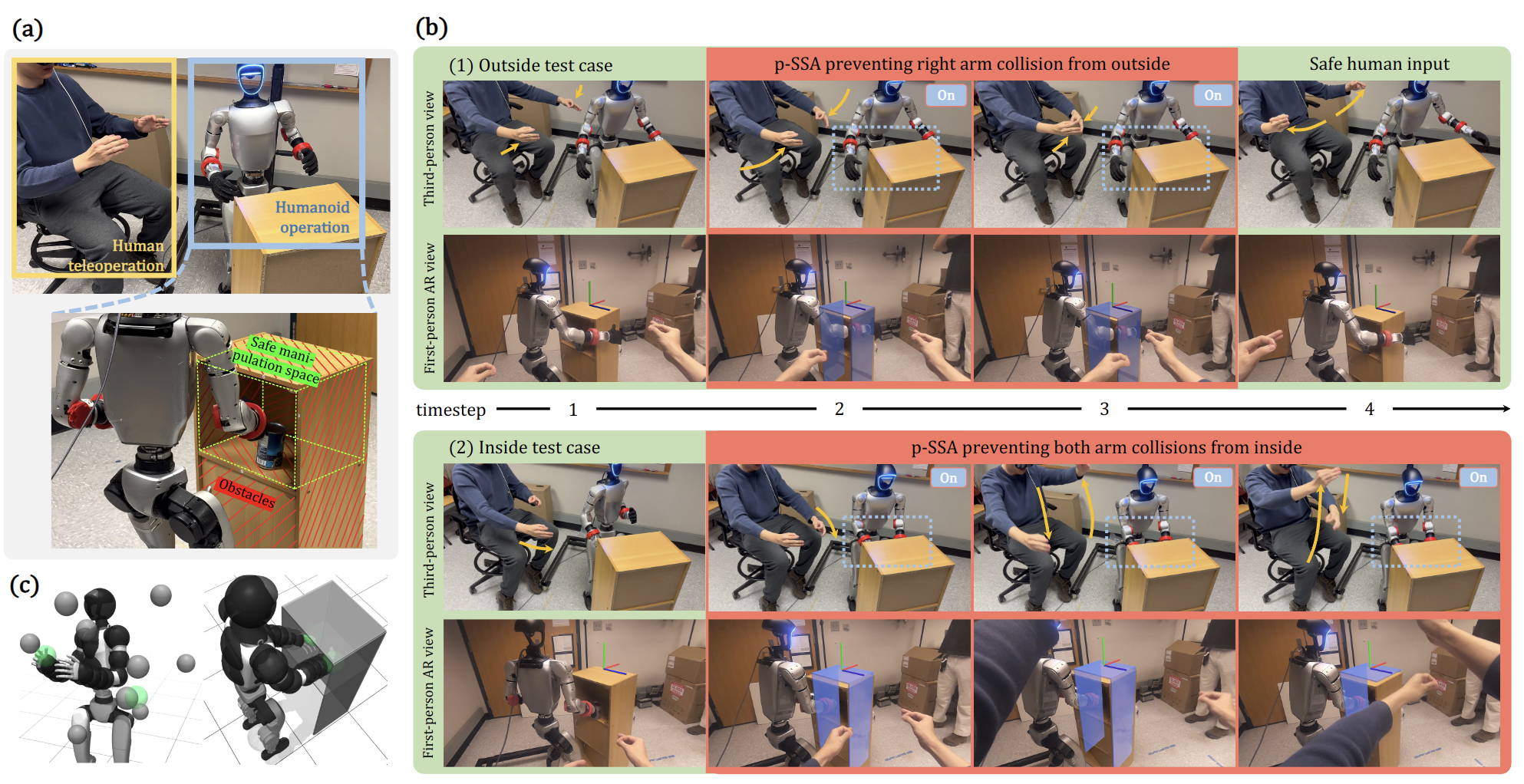
Dexterous safety can require many simultaneous limb-level constraints for external and self-collision avoidance. The Projected Safe Set Algorithm (p-SSA) relaxes conflicting constraints by minimizing safety violations while preserving command feasibility.
-
[U] Dexterous Safe Control for Humanoids in Cluttered Environments via Projected Safe Set Algorithm
Rui Chen, Yifan Sun and Changliu Liu
arXiv:2502.02858, 2025
SAFETY BEFORE THE LAST RESORT
Safe-stoppability monitoring
Learn where safe stopping remains possible
PRISM formalizes emergency stopping as a policy-dependent question and uses importance sampling to refine a neural stoppability monitor near rare, safety-critical boundary states.
Project page-
[C115] Learning Safe-Stoppability Monitors for Humanoid Robots
Yifan Sun, Yiyuan Pan, Shangtao Li, Caiwu Ding, Tao Cui, Lingyun Wang and Changliu Liu
IEEE/RSJ International Conference on Intelligent Robots and Systems, 2026
GEOMETRIC-HORIZON SAFETY LEARNING
λ-Reachability
Geometric-Horizon Safety Bellman Equations for Humanoid Safety

SCALABLE REACHABILITY ANALYSIS
Predict future safety violations
λ-Reachability learns a safety value that represents the worst future safety signal under a policy. A geometric rollout horizon lets the learning target interpolate between local one-step updates and longer-horizon safety information.
With terminal survival parameter δ<1, the resulting safety Bellman operator is a contraction. As λ approaches 1, its fixed point approaches the undiscounted reachability objective. The paper evaluates balance and collision-avoidance constraints on simulated and physical humanoids.
-
[C118] λ-Reachability: Geometric-Horizon Safety Bellman Equations for Humanoid Safety
Rui Chen, Shangtao Li, Yifan Sun and Changliu Liu
Conference on Robot Learning, 2026
MODEL-BASED WHOLE-BODY CONTROL
Make nonlinear dynamics easier to control
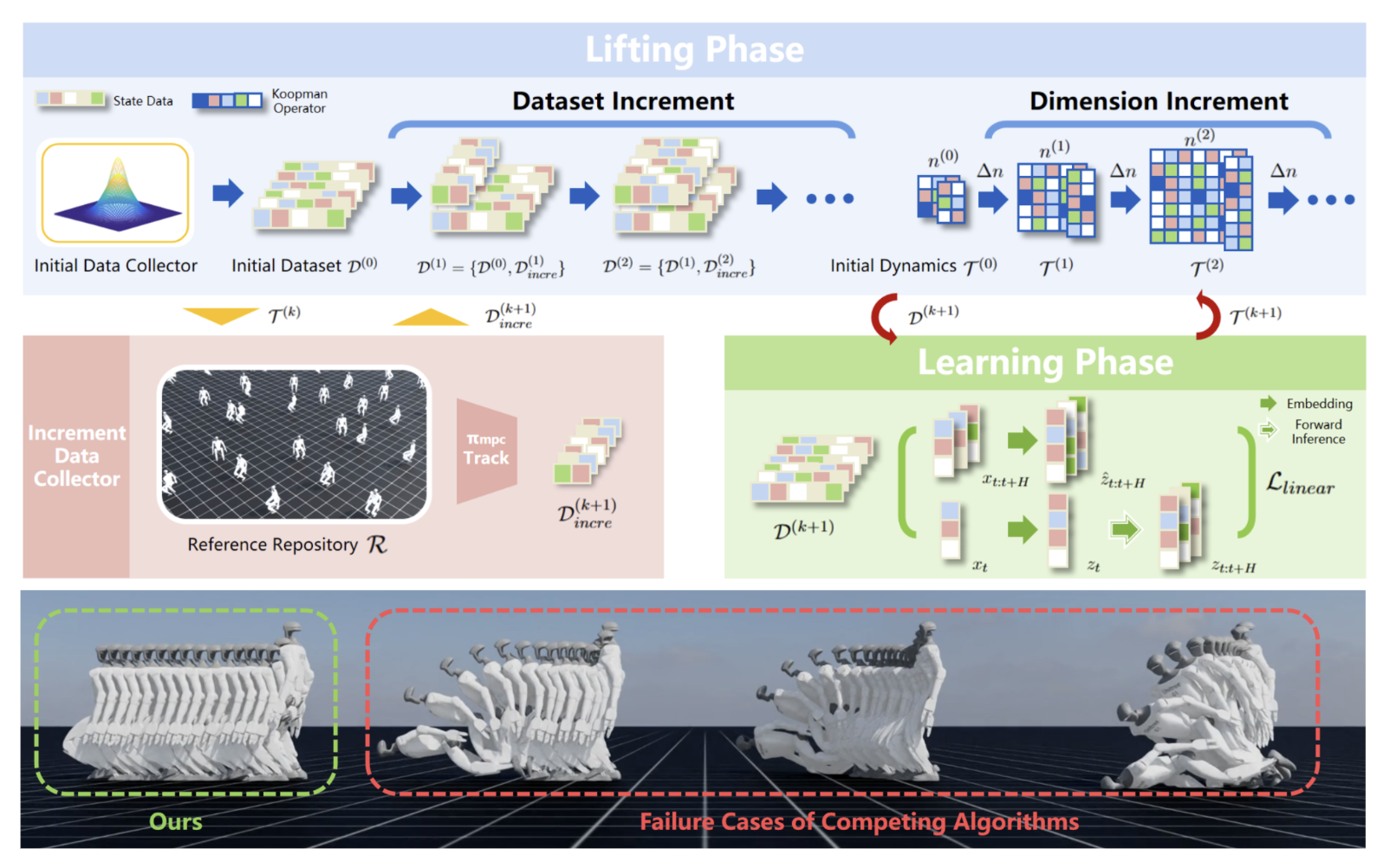
Koopman operator methods lift nonlinear robot dynamics into representations where efficient linear control tools can be applied.
LEARNED LINEAR DYNAMICS
Koopman learning and control
The continual-learning method progressively expands its dataset and latent space, with theoretical analysis showing monotonically converging linear approximation error. Experiments use linear MPC on Unitree G1, H1, A1, and Go2 robots and ANYmal D across multiple terrains.
-
[C95] Continual Learning and Lifting of Koopman Dynamics for Linear Control of Legged Robots
Feihan Li, Abulikemu Abuduweili, Yifan Sun, Rui Chen, Weiye Zhao and Changliu Liu
Learning for Dynamics and Control Conference, 2025
-
[C109] Whole-Body Safe Control of Robotic Systems with Koopman Neural Dynamics
Sebin Jung, Abulikemu Abuduweili, Jiaxing Li and Changliu Liu
IEEE International Conference on Robotics and Automation, 2026
-
[U] Scaling Law of Neural Koopman Operators
Abulikemu Abuduweili, Yuyang Pang, Feihan Li and Changliu Liu
arXiv:2602.19943, 2026
HUMAN-TO-HUMANOID
Transfer human motion into whole-body robot skills
Human motion supplies intent, coordination, and demonstrations for teleoperation and downstream learning.
H2O
A reinforcement-learning motion imitator maps monocular human motion estimates to real-time whole-body humanoid teleoperation.
OmniH2O
A universal whole-body controller supports multiple teleoperation interfaces and provides a route from teleoperated demonstrations to learned whole-body skills.
-
[C79] Learning Human-to-Humanoid Real-Time Whole-Body Teleoperation
Tairan He, Zhengyi Luo, Wenli Xiao, Chong Zhang, Kris Kitani, Changliu Liu and Guanya Shi
IEEE/RSJ International Conference on Intelligent Robots and Systems, 2024
-
[C82] OmniH2O: Universal and Dexterous Human-to-Humanoid Whole-Body Teleoperation and Learning
Tairan He, Zhengyi Luo, Xialin He, Wenli Xiao, Chong Zhang, Weinan Zhang, Kris Kitani, Changliu Liu and Guanya Shi
Conference on Robot Learning, 2024
VERSATILE WHOLE-BODY CONTROL
One body, many modes, real hardware
HOVER unifies multiple command modes in one policy; ASAP explicitly learns from real rollouts to reduce the mismatch between simulated and physical dynamics.
ONE POLICY, MANY MODES
HOVER
HOVER uses full-body motion imitation as a common abstraction for multiple command modes, enabling seamless transitions among navigation and manipulation behaviors without retraining a separate policy for each mode.
ALIGN SIMULATION AND REALITY
ASAP
ASAP pretrains a motion policy in simulation, learns a delta action model from real-world rollouts, then integrates that model into simulation for policy fine-tuning.
-
[C88] HOVER: Versatile Neural Whole-Body Controller for Humanoid Robots
Tairan He, Wenli Xiao, Toru Lin, Zhengyi Luo, Zhenjia Xu, Zhenyu Jiang, Changliu Liu, Guanya Shi, Xiaolong Wang, Linxi Fan and Yuke Zhu
IEEE International Conference on Robotics and Automation, 2025
-
[C97] ASAP: Aligning Simulation and Real-World Physics for Learning Agile Humanoid Whole-Body Skills
Tairan He, Jiawei Gao, Wenli Xiao, Yuanhang Zhang, Zi Wang, Jiashun Wang, Zhengyi Luo, Guanqi He, Nikhil Sobanbab, Chaoyi Pan and others others
Robotics: Science and Systems, 2025
HUMANOID MANIPULATION
From coordinated motion to useful work
These projects combine perception, locomotion, bimanual manipulation, and task-level structure for object interaction and logistics.
-
[C110] VIRAL: Visual Sim-to-Real at Scale for Humanoid Loco-Manipulation
Tairan He, Zi Wang, Haoru Xue, Qingwei Ben, Zhengyi Luo, Wenli Xiao, Ye Yuan, Xingye Da, Fernando Castañeda, Shankar Sastry, Changliu Liu, Guanya Shi, Linxi Fan and Yuke Zhu
IEEE/CVF Conference on Computer Vision and Pattern Recognition, 2026
-
[W] NeSyPack: A Neuro-Symbolic Framework for Bimanual Logistics Packing
Bowei Li, Peiqi Yu, Zhenran Tang, Han Zhou, Yifan Sun, Ruixuan Liu and Changliu Liu
RSS 2025 Workshop on Benchmarking Robot Manipulation: Improving Interoperability and Modularity, 2025
Project video
Student opportunities
Interested in working on Humanoid Robotics?
We welcome students interested in humanoid safety, whole-body control, robot learning, sim-to-real transfer, and loco-manipulation. Prospective researchers should identify the project area that best matches their interests and contact us with a brief description of their background and goals.
Research portfolio