
Agentic Robotics: Tool-Grounded Intelligence
We develop robotic agents that compose reusable tools and physical priors to solve open-ended tasks and bridge simulation with real-world execution.
Vision
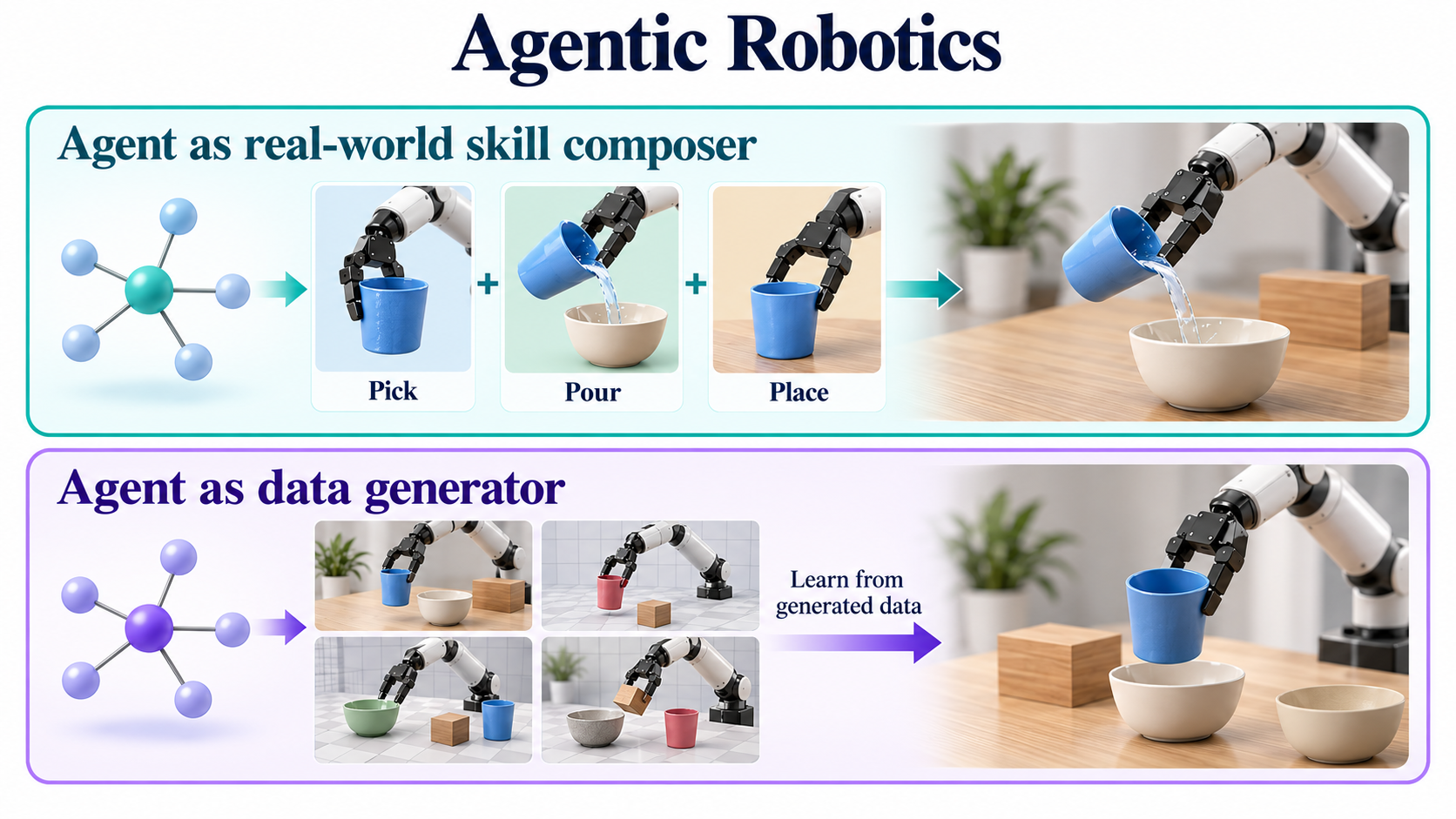
Robots must act in physical environments where objects, contacts, and task details vary from one attempt to the next. A fixed pipeline can be brittle when its assumptions do not match the scene, while a general-purpose agent without physical grounding can propose plans that are impossible to execute. We aim to bring the adaptability of agentic reasoning together with the reliability of robotics tools.
Our vision is for robotic agents to replace hand-authored, task-specific reasoning with flexible orchestration of reusable tools. An agent interprets a goal, decides what information is missing, and composes capabilities such as perception, simulation, geometric reasoning, motion planning, skill libraries, and feedback control. These tools serve as structured priors: they encode useful physical knowledge and validated procedures, so the agent can reason and act without having to rediscover geometry, dynamics, or execution constraints from scratch.
This is not a move from structure to unconstrained language generation. The agent chooses and adapts the structure supplied by its tools; physics checks, grounded geometry, and controllers keep its proposals tied to what a robot can do. The resulting loop can inspect a scene, build or update a model, test a candidate plan, execute it, and use observed outcomes to revise the next action.
Research Directions
Agentic Real2Sim2Real Data Generation
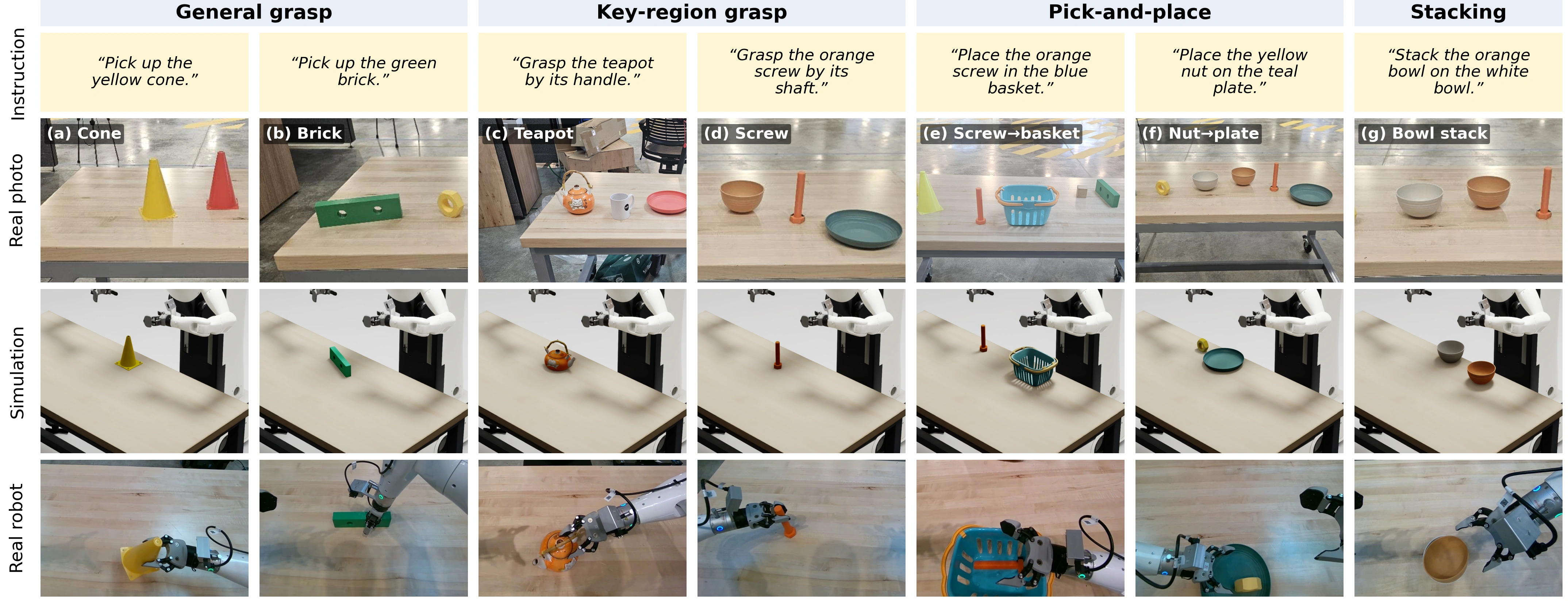
Simulation can make robot learning faster and safer, but building a useful simulation from a real task is itself labor-intensive. ARSTAG uses coordinated language agents to turn a single RGB image and an instruction into task-specific simulation scenes, feasible robot demonstrations, and task-consistent randomized data. The generated experience can then support policy training and evaluation before deployment on physical robots.
This direction treats simulation as an active tool in the agent’s workflow, not merely a source of synthetic images. Agents use scene reconstruction and demonstration generation to create data that reflects the task, then use real-world outcomes to measure how well the resulting policies transfer. The work evaluates seven manipulation tasks across three visuomotor policy architectures on a dual-arm robot; the reported pi0.5 policy reaches 74.6% average real-world success.
Publication:
-
[U] ARSTAG: An Agentic Real2Sim2Real System for Task-Specific Robot Data Generation
Bowei Li, Yuner Zhang and Changliu Liu
arXiv:2609.24563, 2026
Geometry-Grounded Skill Composition
Long-horizon manipulation requires more than selecting a familiar skill: the robot must determine whether a skill’s requirements match the current scene and instantiate its actions for the objects at hand. ManiSkillFormer connects reusable skill schemas to observations through explicit geometric contracts. An LLM agent specifies the geometry a skill needs and corresponding motion templates; perception grounds task-relevant 3D geometry, and the system uses it to instantiate a reusable skill.
These contracts act as a prior over what a skill needs to succeed. They make the agent’s reasoning inspectable and connect semantic task descriptions to concrete geometry and motion, without requiring new demonstrations or per-object policy fine-tuning. Evaluations include pick-and-place across 30 instances from eight object categories, functional manipulation, and long-horizon tasks on a dual-arm robot.
Publication:
-
[U] ManiSkillFormer: Demonstration-Free Compositional Manipulation via Task-Conditioned Geometric Contracts
Peiqi Yu, Mosam Dabhi, Shangtao Li, Bowei Li, Laszlo Jeni and Changliu Liu
arXiv:2609.16331, 2026
Unifying Goal
Together, these directions explore how agents can use simulation, geometric contracts, reusable skills, and robot feedback as complementary sources of structure. The long-term goal is a system that can turn a new instruction and a changing scene into a grounded model, a feasible plan, and reliable physical action, while using simulation and execution feedback to improve transfer. Rather than asking one model to learn every capability end to end, we aim to let an agent compose the right tools and priors for each task and expose enough of that process to validate its decisions in the real world.
Student opportunities
Interested in working on Agentic Robotics?
We welcome students interested in agentic robotics, tool-using agents, robot learning, simulation, sim-to-real transfer, and manipulation. Prospective researchers should identify the project area that best matches their interests and contact us with a brief description of their background and goals.
Research portfolio