
PerSEVE (Perception by Segmentation, Extensible Visual Ecosystem)
PerSEVE develops dataset and foundation perception models for manufacturing.
PerSEVE website is an interactive web interface for browsing large-scale 3D assets, corresponding 2D renderings, and IoU-based evaluation results. It unifies model exploration, visual inspection, and evaluation into a single viewer within the ICL website.
Overview
Authentic Data Collection, Data Curation
3D model dataset
We leverage the open-source ABC dataset, which contains approximately one million 3D models. From this collection, we analyze 20,000 models and assess their geometric quality using metrics such as facet count, vertex count, surface area, volume, volume-to-bounding-box ratio, watertightness, and connectivity. Models with poor geometric quality or limited mechanical relevance are removed through a systematic filtering process. The resulting curated dataset can be explored and accessed through an interactive data browser.
Interactive viewer Launch the PerSEVE model browser Open browser

2D synthetic data generation
We use NVIDIA Isaac Sim to automatically generate labeled training images. Varying numbers of 3D models are imported into simulated scenes and assigned randomized positions and orientations. We then apply diverse materials, lighting conditions, and camera viewpoints to produce visually varied renderings. During rendering, the pipeline automatically generates ground-truth annotations, including pixel-accurate segmentation masks, 2D bounding boxes, depth maps, and surface normals.

SAM4MFG Foundation Model Training
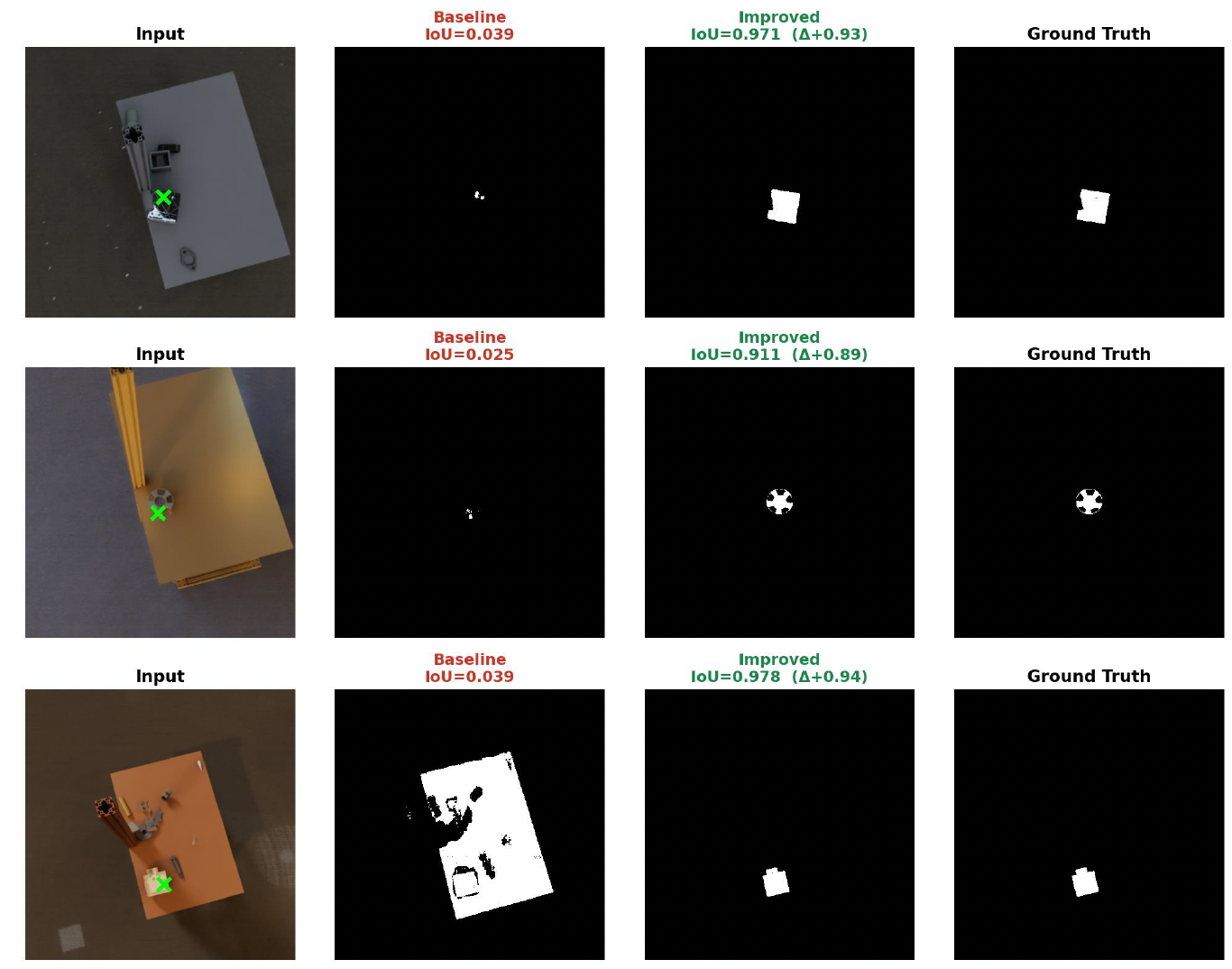
The Segment Anything Model (SAM) is a powerful foundation model for object segmentation that supports multiple prompt types, including points, bounding boxes, text, and visual exemplars. However, industrial imagery differs substantially from the natural-image datasets used to train SAM, resulting in a significant domain gap. To address this limitation, we fine-tune SAM 2.1 using our synthetic industrial dataset. The resulting models substantially outperform the off-the-shelf SAM 2 model in terms of intersection-over-union (IoU) accuracy.
Evaluation gallery Open the IOU evaluation gallery Open gallery

Adversarial synthetic data generation
A closed-loop pipeline for continually improving a fine-tuned segmentation model after conventional fine-tuning has reached a performance plateau. The model is first evaluated to identify failure cases, which are then represented in a shared object–scene feature space and clustered into distinct failure modes. New synthetic scenes are generated by sampling from these clusters, and the model is retrained on the expanded data mixture. Because each iteration starts from the checkpoint produced in the previous round, performance gains accumulate over successive cycles.


CAD-Prompted SAM3
Language-prompted segmentation struggles with uncommon or instance-specific industrial objects, while image exemplars often rely on appearance cues that vary across materials, finishes, and colors. We propose a CAD-prompted segmentation framework built on SAM3 that uses canonical multi-view CAD renderings to provide geometry-based conditioning. Trained on synthetic scenes with randomized appearances, the model enables single-stage mask prediction for objects that cannot be reliably identified through language or appearance alone.

Contributors: Xusheng Luo, Kevin Tang, Rohan Nagabhirava, Jianlin Dou, Bowei Li, Han Zhou, Xiangyu Huang, Yuyang Pang, Yi Li
Publications:
-
[U] CAD-Prompted SAM3: Geometry-Conditioned Instance Segmentation for Industrial Objects
Zhenran Tang, Rohan Nagabhirava and Changliu Liu
arXiv:2602.20551, 2026
Research portfolio